Massachusetts has two dedicated sports psychology graduate programs in 2026, based in Boston and Springfield.
No standalone sports psychologist license exists in the state, so graduates pursue psychology or counseling licensure instead.
Clinical and counseling psychologist employment is projected to grow 11 percent from 2022 to 2032, well above average.
Boston's professional sports franchises and universities create unique practicum and networking opportunities for aspiring sports psychologists.
Massachusetts requires a doctoral degree to use the title "psychologist," which means master's-level graduates entering sports psychology typically pursue licensure as mental health counselors or earn the Certified Mental Performance Consultant credential instead. That distinction shapes every program decision you will make.
The state's dedicated sports psychology master's programs are limited to two campuses in 2026: Boston University and Springfield College. Graduate tuition ranges from roughly $34,000 to $68,000 per year, and both programs are delivered on campus with fall-only start dates. Boston's proximity to professional franchises across all major leagues adds a practical advantage for practicum placements, while Springfield College offers a lower price point rooted in a long applied-science tradition. Students coming from an exercise science, performance psychology background will find either program a natural next step.
Demand is real. The Bureau of Labor Statistics projects 11 percent job growth for clinical and counseling psychologists through 2032, and Massachusetts consistently ranks among the highest-paying states for psychology professionals.
Best Sports Psychology Programs in Massachusetts
Massachusetts is home to two standout institutions offering dedicated sports psychology graduate programs in 2026. Whether you are drawn to the clinical counseling model in Boston or the applied performance psychology tradition in Springfield, both schools prepare graduates for Certified Mental Performance Consultant (CMPC) certification and meaningful careers in the field. Below, we break down what each school and program offers so you can find the right fit.
Factors considered
Program curriculum and credentials
Clinical and applied training hours
Tuition and net price
Institution graduation and retention rates
Delivery format and flexibility
Data sources
Independent program research
Internal program database
NCES-IPEDS federal institutional data — nces.ed.gov
Best for: Students seeking a master's to PhD pathway
Springfield College stands out as one of the few institutions in the country offering a full master's-to-doctorate pipeline in sport and exercise psychology, all on a single campus rooted in a long tradition of human performance education. With three distinct program options (an on-campus MEd or MS, a fully online MEd, and a PhD), Springfield gives students the flexibility to match their career goals and learning preferences. The on-campus programs feature hands-on work in the college's Human Performance Lab, while the doctoral track prepares graduates for academic and consulting careers through collaborative research and a Preparing Future Faculty Series. Tuition is $33,722 per year with a net price of $30,587, and the institution-wide graduation rate is 74.2%.
MEd/MS in Sport and Exercise Psychology — On-Campus
36-credit program completed in two years on campus
Best for: Clinically focused counselors in the Boston area
Boston University brings a clinical counseling lens to sport psychology through its EdM in Counseling with a Sport/Performance Psychology concentration, housed within the Wheelock College of Education and Human Development. The program is designed for students who want to combine licensed mental health counseling with applied sport psychology, requiring 74 units and more than 700 clinical training hours, including sport-specific practica and internships across the Boston metro area. BU's dedicated Director of Clinical Sports Psychology and Athlete Wellness within its athletics department creates a robust internal ecosystem for student exposure to athlete mental health work. Annual tuition is $67,626, but the net price drops to $24,402 after aid; the institution-wide graduation rate is 88.7% with a 10:1 student-to-faculty ratio.
EdM in Counseling with a concentration in Sport/Performance Psychology, Sport/Performance Psychology — On-Campus
74-unit program completed in two years full-time
700+ clinical hours including sport psychology practica
Prepares graduates for Massachusetts counseling licensure
Meets CMPC certification requirements through AASP
Includes summer session and sequenced coursework
Focus on child, adolescent, and young adult populations
Part-time option available for added flexibility
Ecological and strengths-based theoretical approach
Program Comparison: Tuition, Format & Earnings at a Glance
The table below provides a side-by-side look at the two ranked sports psychology master's programs in Massachusetts across key decision metrics. Note that net price figures reflect institution-wide averages (not program-specific costs), and median earnings represent outcomes ten years after enrollment across all programs at each school. Program-level earnings data one year after completion is not yet available for either program.
School
Degree Offered
Degree Level
Tuition (In-State)
Tuition (Out-of-State)
Avg. Net Price (Institution-Wide)
Format
Median Earnings (10 Yr, All Programs)
Median Graduate Debt
Boston University
EdM in Counseling, Sport/Performance Psychology Concentration
Master's
$67,626
$67,626
$24,402
On-Campus
$83,238
$23,250
Springfield College
MEd/MS in Sport and Exercise Psychology
Master's
$33,722
$33,722
$30,587
On-Campus
$48,036
$26,250
Questions to Ask Yourself
Do you want to become a licensed psychologist or a mental performance consultant?
This distinction shapes your entire educational path. Licensed psychologists in Massachusetts need a doctoral degree, while a master's degree can qualify you to work as a mental performance consultant in applied settings.
Is an on-campus cohort experience important to you, or do you need the flexibility of online coursework?
On-campus programs offer built-in mentorship, practicum networks, and peer collaboration that are hard to replicate remotely. Online formats, however, let working professionals and career-changers maintain jobs or athletic commitments while completing coursework.
Are you planning to pursue CMPC certification, and does the program align with AASP requirements?
Not every graduate program covers the specific coursework and supervised experience hours required for the Certified Mental Performance Consultant credential. Confirming alignment before you enroll can save you from needing extra courses later.
What is your realistic budget for tuition and living expenses over the full length of the program?
Tuition for Massachusetts sports psychology programs varies widely, and doctoral programs require a longer financial commitment than master's degrees. Factoring in assistantship availability and cost of living, especially in the Boston area, helps you avoid unexpected debt.
Do you eventually want to work with elite athletes, youth sports, or clinical populations?
Some programs emphasize competitive and professional sport performance, while others focus on youth development or clinical mental health with a sport specialization. Matching the program's strengths to your target population improves your job prospects after graduation.
Online vs. On-Campus Sports Psychology Programs in Massachusetts
Massachusetts programs offer a mix of online, on-campus, and hybrid formats, so the right fit depends on your schedule, career goals, and learning style. Several programs in the state provide fully online or hybrid options alongside traditional on-campus tracks. Before you commit to one format, it helps to weigh the practical tradeoffs, especially since supervised clinical hours for licensure in Massachusetts typically require in-person components regardless of how your coursework is delivered.
Pros
Online programs offer scheduling flexibility ideal for working professionals, coaches, or those balancing athletics with graduate study.
Studying online can reduce living costs significantly, especially compared to renting in the Boston metro area.
Online formats let you enroll from anywhere in Massachusetts, whether you live on Cape Cod, in the Berkshires, or outside the state entirely.
On-campus programs provide direct access to practicum placements near Boston's professional sports teams, collegiate athletic departments, and elite training centers.
Face-to-face mentorship with faculty who maintain active consulting practices helps students build real-world clinical and performance skills.
On-campus students benefit from in-person networking with classmates, visiting professionals, and university athletic programs, connections that often lead to internships and job referrals.
Cons
Online students may need to arrange their own local practicum or clinical placements, which can be challenging outside major metro areas.
Remote learners can miss spontaneous mentorship opportunities and the collaborative energy of cohort-based, in-person programs.
On-campus programs generally carry higher total costs once you factor in housing, commuting, and parking in the Boston area.
Rigid class schedules for on-campus programs can conflict with work obligations or personal coaching commitments.
Regardless of format, Massachusetts licensure requires supervised clinical hours completed in person, so fully remote completion is not possible for those seeking licensure.
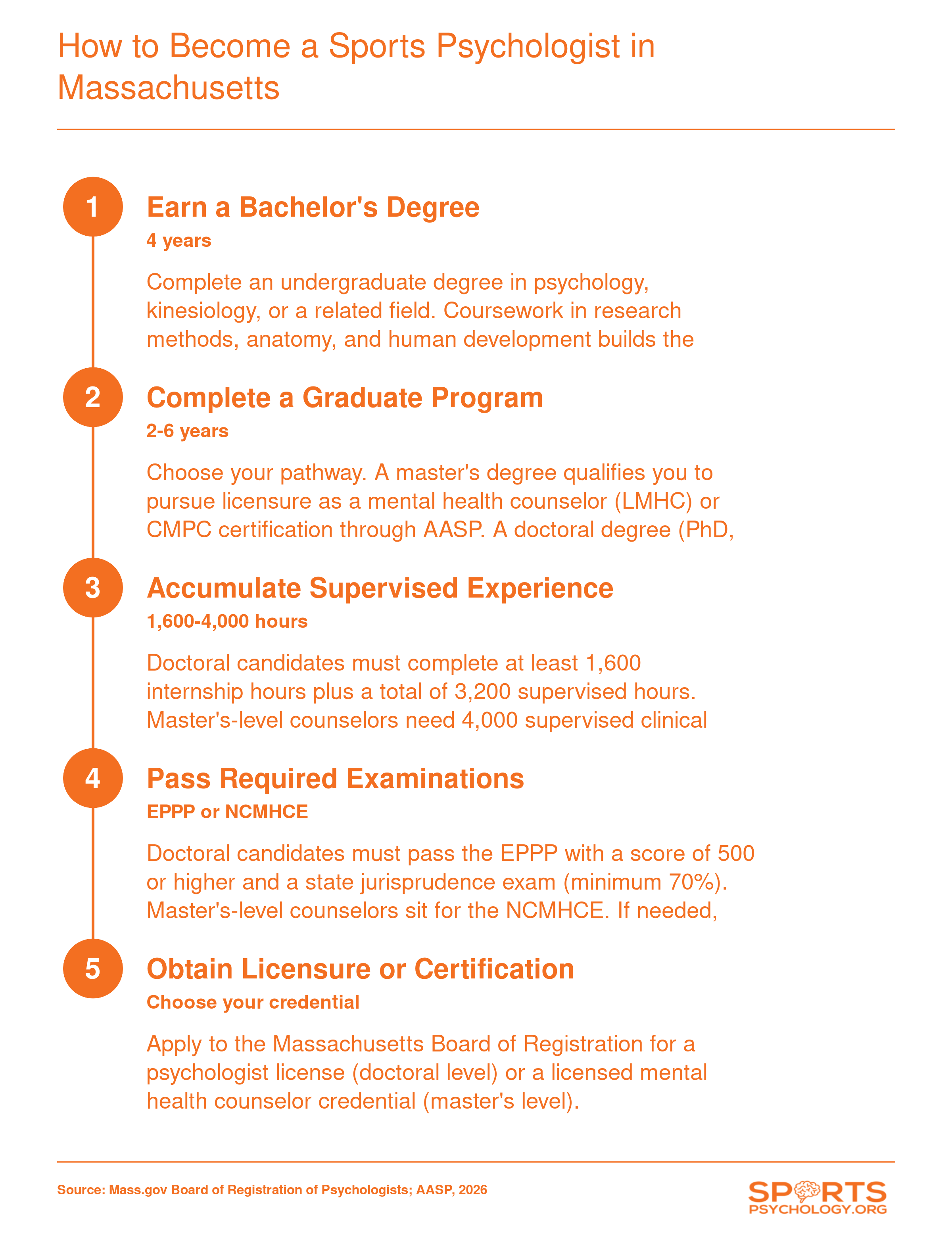
How to Become a Sports Psychologist in Massachusetts
Massachusetts offers multiple credentialing pathways for aspiring sports psychology professionals. The route you choose depends on whether you plan to use the legally protected title of 'psychologist' (which requires a doctorate) or work as a licensed mental health counselor or certified mental performance consultant at the master's level. Here is the step-by-step credentialing ladder.
Sports Psychology Licensure & Certification in Massachusetts
One of the most important things to understand before choosing a program is that Massachusetts does not offer a standalone "sports psychologist" license. Instead, practitioners who work in sports psychology operate under either a psychology license or a counseling license, depending on their degree level. Knowing which credential fits your career goals will save you time, money, and frustration down the road.
Licensed Psychologist Pathway (Doctoral Level)
If you want to provide clinical mental health services to athletes, including diagnosing and treating conditions like anxiety, depression, or eating disorders, you will need to become a licensed psychologist in Massachusetts. This pathway requires:
Doctoral degree: A PhD or PsyD in psychology from an accredited institution.
Supervised experience: A minimum of 3,200 hours of supervised professional experience, including both pre-doctoral and post-doctoral hours.
EPPP exam: You must pass the Examination for Professional Practice in Psychology, a national standardized test covering core areas of psychological knowledge.
Jurisprudence exam: Massachusetts also requires passing a state-specific jurisprudence exam that covers the laws and regulations governing psychology practice in the commonwealth.
This is the route to pursue if you want the broadest possible scope of practice, including the ability to integrate clinical treatment with performance enhancement work.
Licensed Mental Health Counselor Pathway (Master's Level)
For graduates with a master's degree, the Licensed Mental Health Counselor (LMHC) credential is the most common alternative. Massachusetts requires:
Master's degree: A minimum of 60 graduate semester hours in counseling or a closely related field from an accredited program.
Supervised experience: Completion of post-master's supervised clinical hours as defined by the state Board of Registration of Allied Mental Health and Human Services Professionals.
Licensing exam: Passing a national counseling examination, typically the National Clinical Mental Health Counseling Examination (NCMHCE).
The LMHC credential allows you to provide counseling services, including work with athletes on issues such as performance anxiety, transition challenges, and general mental wellness. It does not, however, permit you to call yourself a psychologist or perform psychological testing. If you are exploring how licensure works in neighboring states, our guide to sports psychology programs in Connecticut offers a useful comparison.
CMPC Certification From AASP
The Certified Mental Performance Consultant (CMPC) credential, offered by the Association for Applied Sport Psychology, is the gold standard for non-clinical performance work. It signals to clients, teams, and organizations that you have specialized training in applied sport psychology. The requirements include:
Degree: A master's or doctoral degree in sport science or psychology from a regionally accredited institution.1
Coursework: Completion of courses spanning eight required knowledge areas, covering topics from sport psychology foundations and psychopathology to diversity and cultural competence.2 AASP offers an online course for the diversity and culture knowledge area for candidates whose programs did not include it.3
Mentored experience: A total of 400 hours of mentored experience, including at least 200 hours of direct client contact (with a minimum of 100 hours specifically with sport clients), 150 hours of support activities, and 40 to 50 hours of mentorship meetings with an AASP-approved mentor (at least 20 of those individual and 10 focused on direct knowledge application).4
Exam: A computer-based examination administered via live online proctoring.2 Candidates receive a six-month scheduling window after their application is approved.1
Ethics: Agreement to abide by the AASP Ethics Code.1
Renewal: The CMPC must be renewed every five years, requiring 75 continuing education units.5
Several Massachusetts programs align their curricula with AASP's knowledge area requirements, which can make the path to CMPC certification more straightforward. When evaluating programs on sportspsychology.org, look for those that explicitly reference AASP coursework alignment.
When Do You Need a Doctorate?
The short answer: it depends on the type of work you want to do. If your goal is applied mental performance consulting, helping athletes with goal setting, visualization, focus, and team dynamics, a master's degree paired with CMPC certification is often sufficient. Many successful practitioners in Massachusetts work in this capacity with college teams, youth sports organizations, and individual athletes.
A doctorate becomes necessary when you want to provide clinical psychological services, conduct psychological assessments, or hold certain positions in hospital or university counseling center settings. It also opens doors to academic research and teaching roles. If you are drawn to treating clinical disorders alongside performance work, a PsyD or PhD program with a sport psychology concentration will serve you best.
Planning your credential pathway early, ideally before you even apply to a program, ensures that every course and practicum hour counts toward the license or certification you ultimately need.
The Bureau of Labor Statistics projects that employment for clinical and counseling psychologists will grow by 11 percent from 2022 to 2032, a rate much faster than the average for all occupations. This rising demand signals strong long-term career prospects for graduates of sports psychology programs in Massachusetts and nationwide.
Career Outcomes & Salary for Sports Psychologists in Massachusetts
One of the most common questions prospective students ask is straightforward: what will I actually earn after graduation? The answer depends on your degree level, years of experience, and the type of work you pursue. Here is what the data tells us, along with honest context about what remains uncertain.
What Program-Level Earnings Data Shows
Program-specific earnings for sports psychology graduates from Massachusetts schools are not yet publicly reported at the granular level many applicants hope to see. Neither Boston University's EdM in Counseling (Sport/Performance Psychology concentration) nor Springfield College's MEd/MS in Sport and Exercise Psychology has published program-level graduate salary figures through federal reporting channels. That means you will need to rely on broader occupational wage data and alumni networks to set realistic expectations.
Salary Ranges by Degree and Experience
Bureau of Labor Statistics data paints a useful, if wide, picture. Nationally, the median annual wage for psychologists in specialty categories (which includes sport psychology practitioners) was approximately $117,750 as of 2023, with the range stretching from around $47,450 at the 10th percentile to over $157,420 for top earners.1 In Massachusetts specifically, the mean annual wage for this group was roughly $122,690, reflecting the state's higher cost of living and strong demand for behavioral health professionals.1
Clinical and counseling psychologists, a category many doctoral-level sport psychologists fall into, earned a national median of about $95,830, with entry-level salaries near $50,470 and experienced practitioners reaching $170,150 or more.2
For master's-level graduates who work primarily as mental health counselors (a common early-career title before full licensure), the national median was approximately $63,700 as of 2024, with those at the 80th percentile earning around $88,400.3 Expect entry-level positions in Massachusetts to land somewhere in the $50,000 to $70,000 range, with significant growth possible once you obtain licensure and build a client base or secure a role with a high-profile organization.
Common Employers in Massachusetts
The state offers a uniquely rich job market for sports psychologists. Potential employers include:
Professional sports teams: The Patriots, Celtics, Red Sox, and Bruins all operate in Massachusetts, and each franchise increasingly invests in mental performance staff.
NCAA Division I programs: Schools like Boston University, Boston College, and UMass Amherst maintain athletic departments that hire or contract with sport psychology consultants.
Private practice: Many experienced practitioners build caseloads working with competitive athletes, performing artists, and first responders across the Greater Boston area.
Hospitals and clinics: Medical centers throughout the state integrate behavioral health services that can include performance psychology, especially in rehabilitation settings.
If you are considering programs outside New England, you may also want to explore sports psychology programs in California or other states with robust professional sports markets.
Weighing Earnings Against Debt
Tuition is a real consideration. Boston University's program carries annual tuition of roughly $67,626, while Springfield College comes in around $33,722 per year. Program-level debt and return-on-investment figures for these specific sport psychology tracks are not yet available through federal sources, though institution-wide data suggests that BU graduates generally see a strong earnings trajectory over time and Springfield College offers a more affordable entry point.
As a practical rule of thumb, try to keep total student debt below your expected first-year salary. If you are entering a master's-level counseling role earning in the mid-$50,000s to mid-$60,000s, a program with total costs well above that threshold may require careful financial planning, whether that means securing assistantships, scholarships, or part-time work during your studies.
The bottom line: sports psychology can be a financially viable career in Massachusetts, especially once you move beyond entry-level roles. Doctoral practitioners and those with established private practices or positions with professional teams tend to earn significantly more, but even master's-level graduates can build stable careers with the right combination of credentials and hustle.
Sports Psychology Programs in the Boston Area
Boston stands out as one of the best cities in the country for aspiring sports psychologists, and the reasons go well beyond academics. The metro area is home to professional franchises across every major league (the Celtics, Red Sox, Bruins, Patriots, and Revolution), multiple NCAA Division I athletic programs, and a robust sports medicine infrastructure that creates real-world training opportunities most regions simply cannot match.
Boston University: A Flagship Option
One of the most searched programs in the state is Boston University's sports psychology offering, and it deserves the attention. BU's Wheelock College of Education & Human Development offers an EdM in Counseling with a concentration in Sport/Performance Psychology. This is a two-year, full-time program requiring 74 credit units, including a summer session. Students complete over 700 clinical training hours, with sport psychology internships available in the second year. The program prepares graduates for Massachusetts licensure and meets the requirements for Certified Mental Performance Consultant (CMPC) certification.
BU's program tuition runs approximately $67,626 per year, though the university's net price for aided students is notably lower at around $24,402. A part-time option exists for students who need scheduling flexibility, though that extends the timeline beyond two years. Admission is competitive, with a fall-only start.
Practicum and Internship Advantages
Training in a major sports market gives Boston-area students access to practicum placements that are hard to replicate elsewhere. Between the professional teams, D1 programs at Boston University, Boston College, and Northeastern, and the area's concentration of sports medicine clinics and rehabilitation centers, students can build a diverse clinical portfolio before they graduate. These connections often translate directly into job offers or referral networks after licensure.
Practical Considerations for Prospective Students
Boston's cost of living is among the highest in the Northeast, so budgeting matters. A few things to keep in mind:
Housing: Expect to pay a premium for rent near campus. Many BU students live along the Green Line corridor or in neighboring Allston and Brookline.
Commuting: Boston's public transit system (the MBTA) connects most universities, but delays are common. Factor commute time into your schedule if your practicum site is across town.
Part-time work: Clinical training hours in the second year of BU's program run 20 to 24 hours per week, which limits outside employment. Plan your finances accordingly.
Students who want to stay in Massachusetts but prefer a lower cost of living may also want to consider Springfield College, located about 90 miles west. Its MEd/MS in Sport and Exercise Psychology is a 36-credit, two-year program with tuition around $33,722 per year, and the Springfield area is significantly more affordable for housing and daily expenses.
For those whose career goals center on working with elite athletes, coaching staffs, or professional organizations, training in the Boston area provides a meaningful head start. Students interested in emerging specialties like esports psychology should note that Boston's tech-forward culture also supports growing opportunities in that space. The network you build during your program can shape your career trajectory for years to come.
Frequently Asked Questions About Massachusetts Sports Psychology Programs
Choosing the right sports psychology program involves weighing admissions requirements, career goals, and practical details like format and cost. Below are answers to the questions prospective students ask most often about Massachusetts programs.
What colleges in Massachusetts offer sports psychology programs?
Several institutions offer graduate programs in sport psychology or closely related concentrations. Boston University, Springfield College, and the University of Massachusetts Amherst are among the most well known. Other options include Merrimack College and William James College. Each program differs in emphasis, so review curricula carefully to find the best fit for your career goals.
Do you need a doctorate to be a sports psychologist?
It depends on how you want to practice. In Massachusetts, providing therapy as a licensed psychologist requires a doctoral degree (PhD or PsyD). However, if your goal is mental performance consulting rather than clinical work, a master's degree combined with the Certified Mental Performance Consultant (CMPC) credential can qualify you. Your intended scope of practice determines the degree level you need.
How much does a sports psychologist make in Massachusetts?
Salaries vary by setting and experience. Clinical psychologists in Massachusetts earn a median annual wage in the range of roughly $95,000 to $110,000, according to Bureau of Labor Statistics data. Sport psychology professionals in private consulting or collegiate athletics may earn more or less depending on clientele, specialization, and whether they hold a doctoral license.
Which Massachusetts programs prepare you for CMPC certification?
Programs at Boston University, Springfield College, and UMass Amherst align well with CMPC requirements from the Association for Applied Sport Psychology. Look for curricula that include coursework in sport psychology foundations, performance enhancement, ethics, and a supervised mentored experience. Completing these elements during your degree streamlines the CMPC application process after graduation.
Do sports psychology master's programs in Massachusetts require the GRE?
GRE policies vary by institution and have shifted in recent years. Some Massachusetts programs have made the GRE optional or eliminated it entirely, while others still require scores for admission. Check each program's current admissions page for the latest policy, as requirements can change from one application cycle to the next.
What are the admissions prerequisites for sports psychology graduate programs?
Most programs expect a bachelor's degree with foundational coursework in psychology, such as introductory psychology, research methods, and statistics. Some programs also prefer coursework in exercise science or kinesiology. Strong letters of recommendation, a personal statement explaining your interest in sport psychology, and relevant experience (coaching, athletics, or research) typically round out competitive applications.
Can you complete a sports psychology degree online in Massachusetts?
Yes, several Massachusetts institutions offer fully online or hybrid master's programs in sport psychology or applied psychology with a sport concentration. Online formats can be ideal for working professionals or those balancing athletic commitments. Keep in mind that practicum and supervised experience hours may still require in person attendance, so confirm logistics before enrolling.